Customization available as per your needs. Shop customized products



☰


0
 | 0 Reviews
SKU: 35985
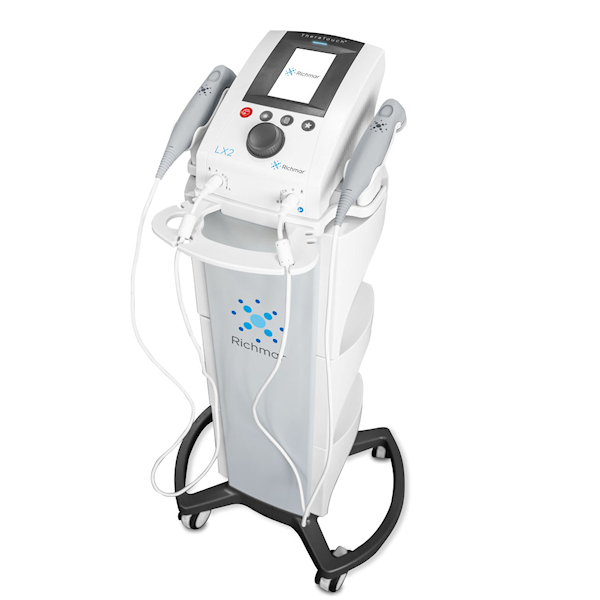
Theratouch LX2 Cold Laser | Advanced Full-featured LLLT | Richmar
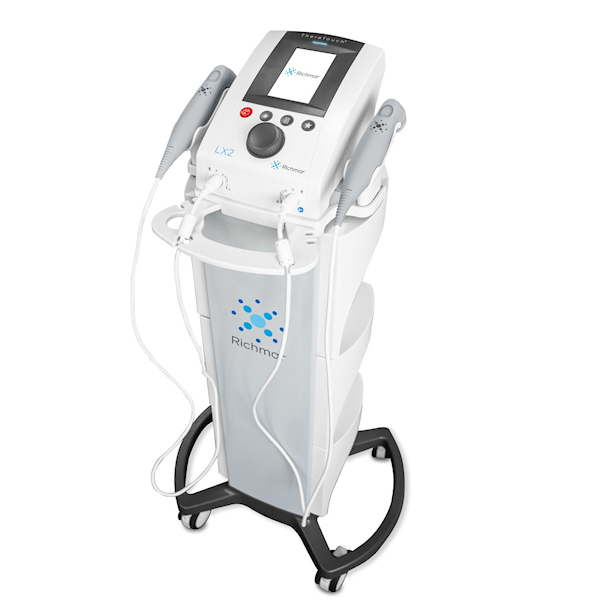
TheraTouch® Cold Laser Model LX2 therapy device emits low-level light therapy(LLLT) and sets the standard in quality and versatility of therapeuti
... Learn moreTheraTouch® Cold Laser Model LX2 therapy device emits low-level light therapy(LLLT) and sets the standard in quality and versatility of therapeutic laser treatments. As a class IIIb laser, it delivers up to 35 joules/cm2 per treatment, with multi-wavelength, frequency and pulse width variability. TheraTouch LX2 may be used to encourage and speed the healing of skin, muscle, tendon and ligament injuries without the burn possibilities of a so-called 'hot laser'. Research suggests that the mode of action for conditions of the neuro-musculo-skeletal functions to increase angiogenesis, reduce inflammation, modulate pain and assist the body's healing of soft tissue and nerve injuries. Easy to follow onboard instructional clinical protocols simplify customization of laser therapy treatments to the needs of each patient. This makes the LX2 not only great for the experienced health care practitioner, but also a great entry-level choice into the use of laser therapy.
Show Less
Starting Price
$3495.00
Shipping charges will be calculated at cart pageAvailable Customizations
Advanced Theratouch LX2 Cold Laser
 Limited lifetime warranty
 Free returns
LLLT Therapy from the Theratouch-Lx2 serves 5 main purposes:
- promotion of wound healing
- analgesic effect
- reducing inflammation and swelling
- soft tissue and nerve tissue repair
- preventing tissue degradation from poor circulation
CONDITIONS THAT RESPOND FAVORABLY TO LLLT
Low Level Laser Therapy is currently used in a wide variety of clinical settings, ranging from myo-fascial conditions, wound healing, dentistry, dermatology, TBI, and rheumatology(decreases inflammation and increases bio-synthesis of new articular cartilage). That being said, more statistical evidence is available to demonstrate the validity of LLLT for treating chronic joint disorders or alleviating pain than for wound healing. The wound healing component is considered controversial by some authorities although even anecdotal evidence is pretty convincing that it helps. Studies are currently underway to show how LLLT may be considered a viable treatment for helping in stroke recovery or coming back from traumatic brain injury(TBI).
One of the most commercially successful applications of LLLT is the stimulation of hair regrowth in balding individuals.
The photobiomodulation activity of LLLT can cause more hair follicles to move from the telogen phase to the anagen phase. Newly formed hair is thicker and more pigmented.
USEFUL PRECAUTIONS WHEN TREATING PATIENTS WITH THE LX2 LASER
Treatment Preparation
- Check the patient for contraindications.
- It may be necessary to prepare the patients skin to allow the laser light to reach the target tissue better and to reduce skin irritation, by cleaning the treatment area with soap and water or alcohol.
- Make sure to dry the area well before starting laser application.
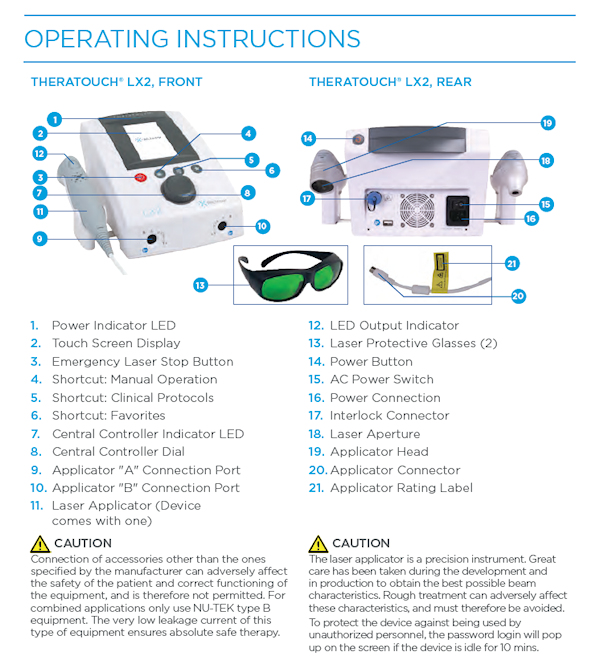
- Both operator and patient MUST wear the PROTECTIVE GLASSES.
During Treatment
- Frequently ask to ensure patients are not experiencing undesired effects from treatment. If necessary the treatment will have to be adapted. The amplitude can be reduced or the continuous mode can be changed to pulsed mode or vice versa.
- Do not look directly into the laser or remove protective glasses prior to treatment ending.
After Treatment
- Ensure the laser output has stopped before removing the protective glasses from the patient and treating clinician.
- Observe the treatment area to ensure no undesired effects have occurred.
- Tell the patient to inform the clinician should they have any adverse reactions.
FEATURES OF THE THERATOUCH LX2 LASER:
- 10 - onboard Pre-programmed Evidence-Based Clinical Protocols: developed with therapeutic researchers, the TheraTouch LX2 populates treatment parameters proven effective for the selected indication, including a Tissue Healing protocol.
- 100 - customize and Save User-defined Protocols
- Full-Color Touchscreen
- The menu-driven user interface guides treatment setup in a straightforward and logical flow, making the device easy to learn and simple to use.
- Deliver up to 35 j/cm2 of LLLT in a single treatment with dosage calculator shown on display
- Programmable treatment time up to 4 minutes
- Continuous or pulsed output modes
- 2 output channels
- Displays dosing measurements in your preferred unit of measure, or all simultaneously, with real time calculation to update each when adjusting treatment output.
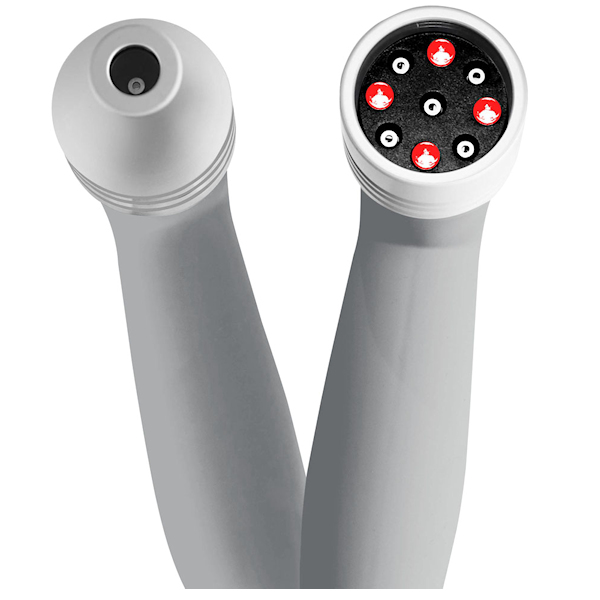
Choice of Two Laser Applicators TheraTouch LX2 comes standard with a 9-diode cluster applicator consisting of:
- Four 650 nm wavelength LED diodes at 10 milliwatts each
- Five 850 nm wavelength infrared laser diodes at 200 milliwatts each
- Above diodes combine for total of 1040 milliwatts of power
Available Add-ons:
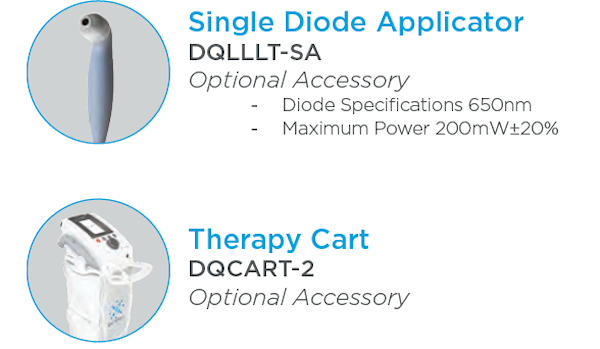
Optional Single Diode Applicator:
- 650 nm wavelength infrared laser diode at 200 milliwatts of power
Optional Therapy Cart:
Transports the TheraTouch LX2 and all accessories from room to room with ease.
IS THERE SCIENCE TO SHOW LASER THERAPY BENEFITS WITH THERATOUCH LX2?
Cold Laser Therapy has been demonstrated to affect molecules, cells, and tissues. Specific modes of action may vary with settings and applications. Within the cell, there is strong evidence to suggest that low-level laser light therapy acts to stimulate mitochondria to increase ATP(energy) and in this process nitric oxide is produced as well.
Additionally, applying
LLLT Therapy induces genes to express themselves in a way that results in increased protein syn.thesis and new blood vessel formation. These factors may speed the healing time for injuries to skin, nerves, muscles, tendons, and ligaments
.
Absorbed photons of light from the laser have been shown to increase cell replication, stimulate tissue re-growth factors and improve oxygenation of tissues in the region the therapy is applied. The increase in growth factors increases motilility of epithelial cells and production of fibroblasts, thereby suggesting it may increase the speed of wound healing and closure.
- 600 - 700 nm are used to treat superficial tissue
- 780 - 950 nm, which penetrate further, are used to treat deeper-seated tissues
- 700 - 770 nm(no benefits) have been found to have limited biochemical activity and are therefore not normally utilized
IMPORTANT: It should be noted that the main tissues that will benefit from LLLT are those that actually absorb the photons vs. just having them pass through. That is why the 600-700 nm (penetrating about 1 to 2cm) wavelengths affect superficial or cutaneous tissue because photons generated at that wavelength are absorbed by the skin not reaching the deeper components. To reach deeper tissues wavelengths of 780-950 nm(penetrating 3 to 4+cm) range carry photons to be absorbed by myo-fascial tissue, joint capsules and articular cartilage.
Comparative Uses: Single diode vs. Multi-diode Semi-conductor Applicators - the results for experimentation comparing single diode vs. multi-diode laser(with multiple LED diodes and Infrared diodes) laser applicators, show the following comparison:- Multi-diode Applicators are often considered more effective at reducing post-exercise CK(creatine kinase). This discovery suggests that a class 3 laser using a multi-diode applicator with a range of wavelengths has a greater variety of uses and have shown to be more effective at speeding recovery while reducing delayed onset muscle soreness.
- Single-diode Applicators are the most effective for more specific purposes. The single-diode applicator included with the LX2 model emits a wavelength of 650nm; making this the choice laser applicator head for skin or dental conditions. However, use and effects may vary depending on adjustment of wavelength, frequency, pulse width, time of exposure and number of treatments.
PHYSICS OF LASER BIO-THERAPEUTICS:
A laser is designed to produce photons traveling parallel to one another in the same direction, essentially concentrating the photons into as small an area as possible. The ability to focus the beam on the problem while adjusting the settings to improve absorption of photons at a desired depth are the more valuable determinates in how desirable the results may be.
NOTE:
2 factors increasing penetration depth of laser therapy:
- greater wattage means greater penetration
- greater wavelengths of light penetrate more deeply
Wavelength
is expressed in nanometers(nm): and is actually defined as the width of the photon beam of light.
Frequency of pulses per second:
LX2 offers both continuous and pulsed laser treatment. By pulsing the laser beam rather than it being continuous, it improves safety and prevents overheating. The time interval between pulses is inversely proportional to the effectiveness of the therapy. Overall, the determination of laser protocol and implementation of such in therapeutic sessions is a complex subject. This is where the pre-programmed settings in the Theratouch LX2 really come in handy because few doctors are experts in the physics and dynamics of laser photo-biomodulation and therapy.
Pulsed or Continuous(CW) Wave Mode:
during a pulsed laser mode session, the total amount of joules of energy absorbed by the tissues is less than when using the continuous laser mode. Therefore, in pulse mode there is less chance of overheating the unit and the patient. On the LX2, pulses per second may be adjusted by adjusting the frequency setting from 1hz - 10,000hz. The total amount of photon energy absorbed by the body is directly proportional to the frequency, yet inversely proportional to the wavelength. So, the higher the pulse frequency, the higher its energy. Yet, the longer the wavelength, the lower the amount of energy absorbed by the body. Pulse mode is generally a safer laser setting than continuous.
Pulsed waves can be provided at a much higher peak power. This reportedly allows deeper penetration of the therapy without thermal damage and provides for a shorter treatment time. Pulsed laser has been determined to be superior to continuous waves (at 10, 25, and 50 Hz) for promoting healing. However, higher pulsed frequencies seem to be more analgesic in effect. There is still much to be learned about appropriate therapeutic dosages to promote a consistent physiological response to obtain either an anti-inflammatory effect, a bio-stimulatory effect, or a bio-inhibitory pain-management effect.
Pulsed or Continuous(CW) Wave Mode:
Pulsed mode maximum is 100% of total energy output(relative to continuous) in a single session; calculated by dividing a session's average power output by number of pulse repetitions per second. Pulse per second may be adjusted by adjusting the frequency setting from 1hz - 10,000hz In pulse mode there is less chance of overheating the unit and the patient. The higher the frequency setting the lower the total energy absorbed. Pulse mode is generally a safer setting than continuous.
Product Notes
LX2 - Advanced Theratouch LX2 Cold Laser
CAUTIONS/ADVERSE REACTIONS:
The LX2 is a Class 3B Laser. Class 3B lasers are hazardous for eye exposure. They may heat skin and materials but are not considered a burn hazard like Class 4 lasers. For visible-light lasers, Class 3B lasers' output power is between 5 and 499 milliwatts.
The desire for therapeutic effectiveness must be balanced with measures to prevent overheating of tissues. This factor of balancing the two is built in to the use and safety features of lasers like the LX2. The protocol are designed to not overheat and certainly not to burn tissues when used as intended.
WHAT CUSTOMERS SAY
0 rating | 0 People reviewed
Discover more
WHAT YOU MAY ALSO LIKE


Contents Funded and Copyright by ©2025 BACK BE BIMBLE. All Rights Reserved.